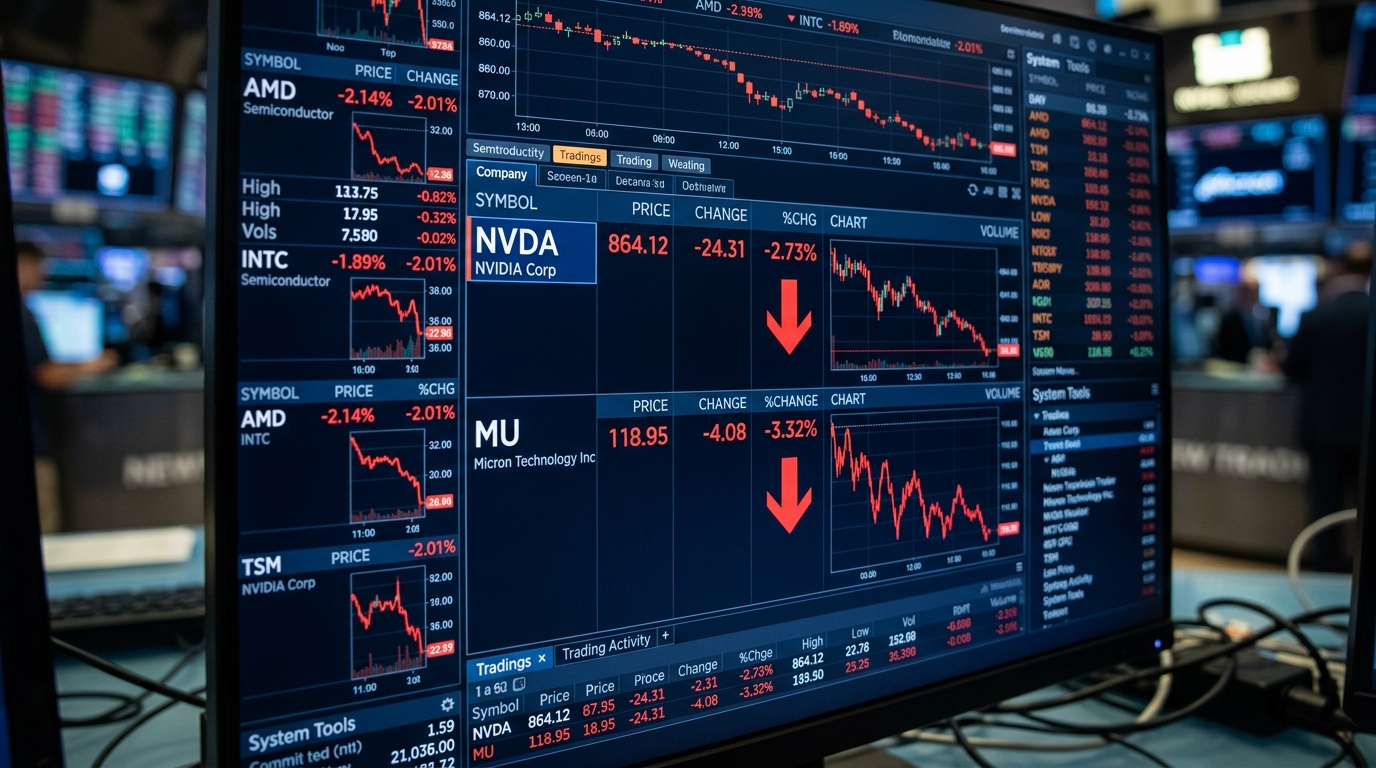
Tuesday's Pre-Market Damage
- Nvidia (NVDA): -2%
- Micron Technology (MU): -8%
- Alphabet (GOOGL, GOOG): Lower, extending Monday losses
- Tech Sector (XLK): Led market declines
- Nasdaq Composite: Down for 2nd consecutive session
What Broke the Momentum
The immediate trigger was last week's Federal Reserve messaging. The hawkish tone—signaling that inflation remains too high for comfort—sent investors scrambling out of this year's market leaders. Technology has been the best-performing sector year-to-date, propelling major indices to all-time highs in recent weeks as the AI narrative dominated. But when the Fed suggests rate hikes could still be on the table, suddenly those lofty valuations look less defensible.
Micron's 8% tumble is particularly striking given it was trading at record highs. The memory chip maker reports earnings Wednesday, and investors clearly decided to derisk ahead of the print rather than ride the euphoria into results.
Alphabet's continued weakness, extending Monday's selloff, underscores how broadly the risk-off sentiment has spread across Big Tech. This isn't just a semiconductor story—it's a systematic retreat from the names that led the rally.
The Chip Sector Cools Across the Board
Nvidia didn't fall alone. AMD, Broadcom, and Intel all declined as the hottest corner of the AI trade gave up ground. These stocks have been the market's darlings, benefiting from insatiable demand for AI infrastructure and computing power. But leadership rotations are rarely gentle, and when sentiment shifts, the highest fliers often fall hardest.
The timing compounds the pressure: expectations that the Fed may need to hike rates arrived just as a massive wave of IPOs threatens to flood the market with AI exposure. SpaceX shares sank for a fourth straight session Tuesday, dropping 16% in the prior session alone. Meanwhile, anticipated public debuts from Anthropic and OpenAI loom on the horizon.
The question investors are now wrestling with: can the market absorb even more richly-valued AI companies when the existing leaders are already under strain? The IPO pipeline isn't slowing, but the appetite clearly is.
Beyond Nvidia: The Broader Chip Selloff
AMD (AMD)
Declined alongside sector peers as AI chip enthusiasm cooled. The company has been a key beneficiary of AI infrastructure buildout but couldn't escape Tuesday's broader rotation out of semiconductors.
Broadcom (AVGO)
Joined the retreat despite its diversified portfolio spanning networking, broadband, and custom AI chips. Even companies with exposure beyond pure AI computing felt the pressure.
Intel (INTC)
Also moved lower, extending the weakness across the entire semiconductor landscape. Intel's ongoing turnaround efforts offer little shelter when macro headwinds and sector rotation dominate.
Why This Matters Now
Tech's dominance this year has been staggering, driving the Nasdaq and S&P 500 to repeated record closes. AI wasn't just a theme—it was *the* theme, with investors pouring capital into anything connected to the buildout of AI infrastructure, from chips to cloud providers to software platforms.
But every parabolic move eventually faces a test. The combination of Fed hawkishness removing the low-rate tailwind and a flood of new AI IPOs competing for capital creates a perfect storm for a valuation reset. Markets don't move in straight lines, and after months of relentless gains, profit-taking was inevitable. The question is whether this is a healthy pullback or the start of something deeper.
For now, the Nasdaq's second consecutive day of losses and the breadth of Tuesday's decline across semiconductors suggest investors are taking chips off the table—literally and figuratively.
FAQ
Why did Micron drop so much harder than Nvidia?
Micron fell over 8% versus Nvidia's 2% because it reports earnings Wednesday. Investors often derisk ahead of earnings events, especially when a stock is at record highs. Memory chip pricing and demand outlook will be closely watched, and with the sector already under pressure, traders didn't want to hold through the uncertainty.
Is the AI trade over?
Not necessarily over, but definitely cooling. The fundamentals driving AI investment—infrastructure buildout, enterprise adoption, model development—haven't changed overnight. What's changed is the macro backdrop (Fed policy) and market technicals (valuations, IPO supply). Pullbacks after parabolic runs are normal. Whether this is a healthy correction or something more depends on how earnings hold up and whether rate expectations stabilize.
How does the SpaceX and AI IPO wave affect existing tech stocks?
New supply matters. When massive IPOs like SpaceX, Anthropic, and OpenAI hit the market, they compete for the same pool of growth-oriented capital currently invested in Nvidia, Alphabet, and peers. If investors want exposure to these new names, they often have to sell existing positions to raise cash—creating selling pressure on current leaders even if their fundamentals remain strong.
This content is for informational purposes only and does not constitute investment advice. All market data and price movements are sourced from publicly available reports. Investors should conduct their own research and consult with financial advisors before making investment decisions. Past performance does not guarantee future results.